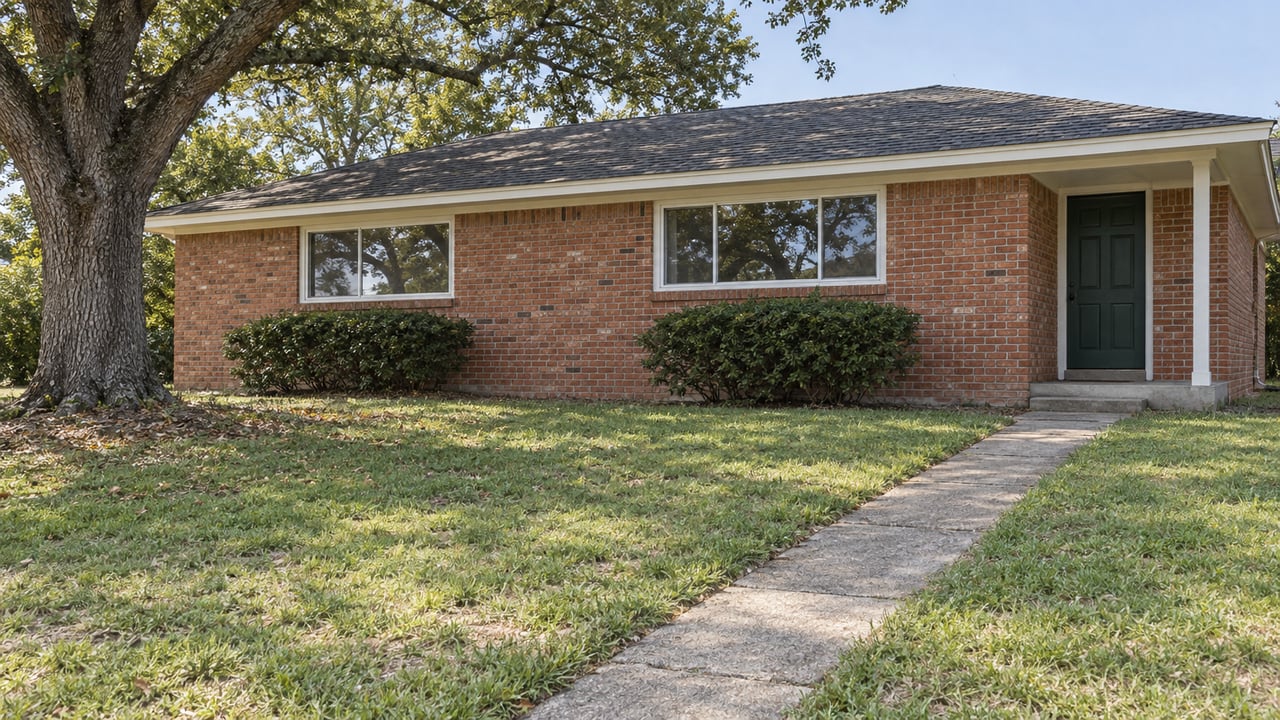
A buyer who spends one Saturday touring Eatonton comes home more confused than when she left. The listing she saw online this week, priced around $410,000, sits three streets from a modest brick ranch that just closed for a fraction of that. Twenty minutes later, past the courthouse square and out toward the lake, a gated community lists its remaining homes above $1.2 million. Same ZIP code. Same "Eatonton" search result. Three completely different price tags.
That's not a fluke in the data. It's what happens when one number is asked to describe three separate housing markets stacked inside a single ZIP code, 31024.
The Number on the Portal
Zillow's home value index for 31024 put the typical Eatonton home at $410,313 as of late September 2026, with appreciation running around 4.1 percent a year over the past five years. That figure gets repeated everywhere: on search portals, in relocation packets, in casual conversation about what it costs to live near the lake.
It's also an average of housing stock that has almost nothing in common. A ZIP-level home value index blends in-town cottages on quarter-acre lots with $1.5 million lakefront estates and golf-course villas, then reports back a single midpoint. The number is accurate. It's just not describing any house a buyer will actually walk through.
Look at closed sales instead of index values and the picture splits further. Over the trailing 12 months through early September 2026, market analytics firm Resideline tracked 84 closed sales in Eatonton with a median sold price of $250,000, measured at $142 per square foot. That's $160,000 below the portal's headline figure, and it's the number that reflects what actually changed hands, not what a model estimates a typical home is worth.
Three Front Doors, One ZIP Code
The gap between $250,000 and $410,000 isn't noise. It's the seam between distinct submarkets that share a mailing address and little else.
| Submarket | What it looks like | Named communities |
|---|---|---|
| In-town and rural inland | Older streets near the square, farmhouses and ranch homes on acreage off the state highways | Represents the bulk of the $250,000 median closed price |
| Lake Sinclair waterfront | Docks, shoreline lots, cottages to newer construction | Lake Sinclair Woods, Riverbend Estates, Oconee Springs Landing |
| Gated golf and lake community | Master-planned, HOA-governed, built out over three decades | Cuscowilla |
Cuscowilla is the clearest example of how far the top end pulls the average. The community sits off Old Phoenix Road and has been built out in phases since 1996, with monthly HOA dues in the $233 to $293 range. As of August 2026, the handful of homes listed for sale there averaged just over $1.2 million, with some individual listings priced well above that.
Lake Sinclair waterfront occupies the middle, with prices generally running from around $400,000 for older cottages and lake-access lots up toward $1.5 million or more for newer deep-water construction. That range alone spans the entire gap between the portal's headline number and the in-town median, before Cuscowilla even enters the picture.
None of this means the $410,313 figure is wrong. It means a single ZIP-level average was never built to answer the question a buyer is actually asking, which is "what will a home like the one I want cost."
The Off-Market Third of the Market
There's a second gap hiding inside the $250,000 figure itself, and it's easy to miss.
Resideline's tracking shows that of the 84 closings counted over the past 12 months, 30 percent never appeared on a listing service at all. These were foreclosure deeds, estate transfers, and other off-market sales, the kind that move through an attorney's office or a family transaction rather than through an agent and the MLS. When those are pulled out and the median is recalculated using only MLS-listed sales, the number rises to $298,800.
That's meaningful for anyone actually shopping the active market. If you're competing for a home the normal way, through a listing agent, an MLS search, and a buyer's offer, the relevant comparison isn't the all-in $250,000 figure. It's closer to $298,800, because the properties that pulled the broader median down were never available to you as a buyer in the first place. They moved through channels most house hunters never see.
Georgia's statewide MLS data reflects a similar pattern at the county level. Putnam County's median sale price sat at $394,156 in March 2026, down slightly from the year before, with 43 homes sold that month against 48 the prior year. County-wide figures fold Eatonton's submarkets together with the rest of Putnam, which is why they land somewhere between the in-town median and the lakefront range rather than describing either one precisely.
What This Means When You're Actually Comparing Houses
The practical fix is simple to state and easy to skip in practice: stop comparing a specific house to a ZIP-code median, and start comparing it to closed sales within its own submarket.
A three-bedroom brick home two blocks from downtown Eatonton should be measured against other in-town closings, where $250,000 is a far more useful anchor than $410,313. A waterfront cottage on Lake Sinclair Woods or Riverbend Estates needs comps from other lake-access sales, not from Cuscowilla's golf-course listings, and not from the inland median either. A home inside Sebastian Cove or Crooked Creek should be priced against its own recent activity, since these established subdivisions carry their own pricing history distinct from both the lake and the in-town core.
This also explains why two houses at the same list price in Eatonton can represent very different value. A $450,000 in-town listing and a $450,000 waterfront cottage are competing in entirely different pools of buyers, with different comparable sales, different days-on-market patterns, and different reasons a seller priced where they did. Treating them as interchangeable because they share a ZIP code is how buyers overpay in one submarket while underestimating another.
Putnam County's broader growth adds context here too. The county's population has grown nearly 3 percent since 2020, with much of that pull tied to interest in both Lake Sinclair and Lake Oconee, according to the Putnam Development Authority. Downtown Eatonton's business district and projects like the Village at Harmony Crossing point to steady investment in the town's core rather than just its waterfront edges, which is one more reason the in-town and lakefront submarkets deserve separate attention instead of one blended number.
FAQ
Does Eatonton's median price include Lake Oconee homes, not just Lake Sinclair? Some of it does. Cuscowilla and a handful of golf-adjacent communities fall inside the 31024 boundary, though most of Lake Oconee's largest gated developments are addressed through Greensboro in neighboring Greene County, so they don't factor into Eatonton's own ZIP-level figures.
Why would a home sale never show up on Zillow or the MLS? Estate settlements, foreclosure deeds, and direct family-to-family sales often close through an attorney rather than a listing agent. Resideline's tracking found this described roughly 30 percent of Eatonton's closings over the past year, which is enough volume to shift the citywide median lower than what active MLS buyers actually experience.
If I'm shopping a specific price range, how do I get a number I can trust? Ask for closed comparable sales from the exact submarket and subdivision you're considering, not the ZIP code average. A median built from three in-town sales tells you more about your target house than a blended figure built from 84 closings spanning a golf course, a lakefront, and a rural county road.
If you're trying to figure out which version of Eatonton actually matches your budget and your list, Kay A McGiboney can pull the closed comps for the specific street or subdivision you're eyeing, not just the ZIP code average, so the number you're working from is the one that actually applies to your search.